Eliminate geometrically impossible and commercially invalid option intersections early to keep configuration tables clean, performant, and error-free.

When parameter inputs multiply across complex product families, unconstrained matrices generate hundreds of theoretical combinations that cannot exist physically. A housing unit of compact width cannot accommodate a high-capacity power module; likewise, an anodized surface treatment may be incompatible with cast aluminum alloys. Pruning cuts these invalid branches directly at the matrix input tier.
Attempting to handle invalid combinations inside downstream feature scripts or assembly mates forces the CAD engine to resolve broken geometry. By removing non-viable permutations before matrix execution, model regeneration remains instantaneous and robust across all user-selected variant configurations.
Pruning logic organizes inputs into ordered tiers. The primary selection acts as a filter on subsequent choices, narrowing available options dynamically rather than presenting full uncurated lists to designers or sales configurators.
Enforce mutually exclusive conditions at the highest parent parameter in the matrix. Never allow child assemblies to evaluate configurations whose parent dimensions violate mechanical clearances.
Maintaining clean configuration tables requires regular logic audits. As new physical parts or engineering revisions enter the product tree, updating pruning tables ensures obsolete configurations disappear without breaking legacy design instances.
Group dependent inputs into unified sub-matrices to isolate failure points before matrix compilation.
Use explicit boolean validation checks on cross-feature dimensions to extinguish ghost variants automatically.
Audit table rows quarterly against commercial ERP catalogs to purge manufacturing-obsolete branches.
Mechanical systems architect focusing on parametric configuration structures, matrix simplification, and CAD automation workflows across multi-tier assemblies.

Techniques for streamlining dense configuration matrices and reducing computational overhead in CAD models.
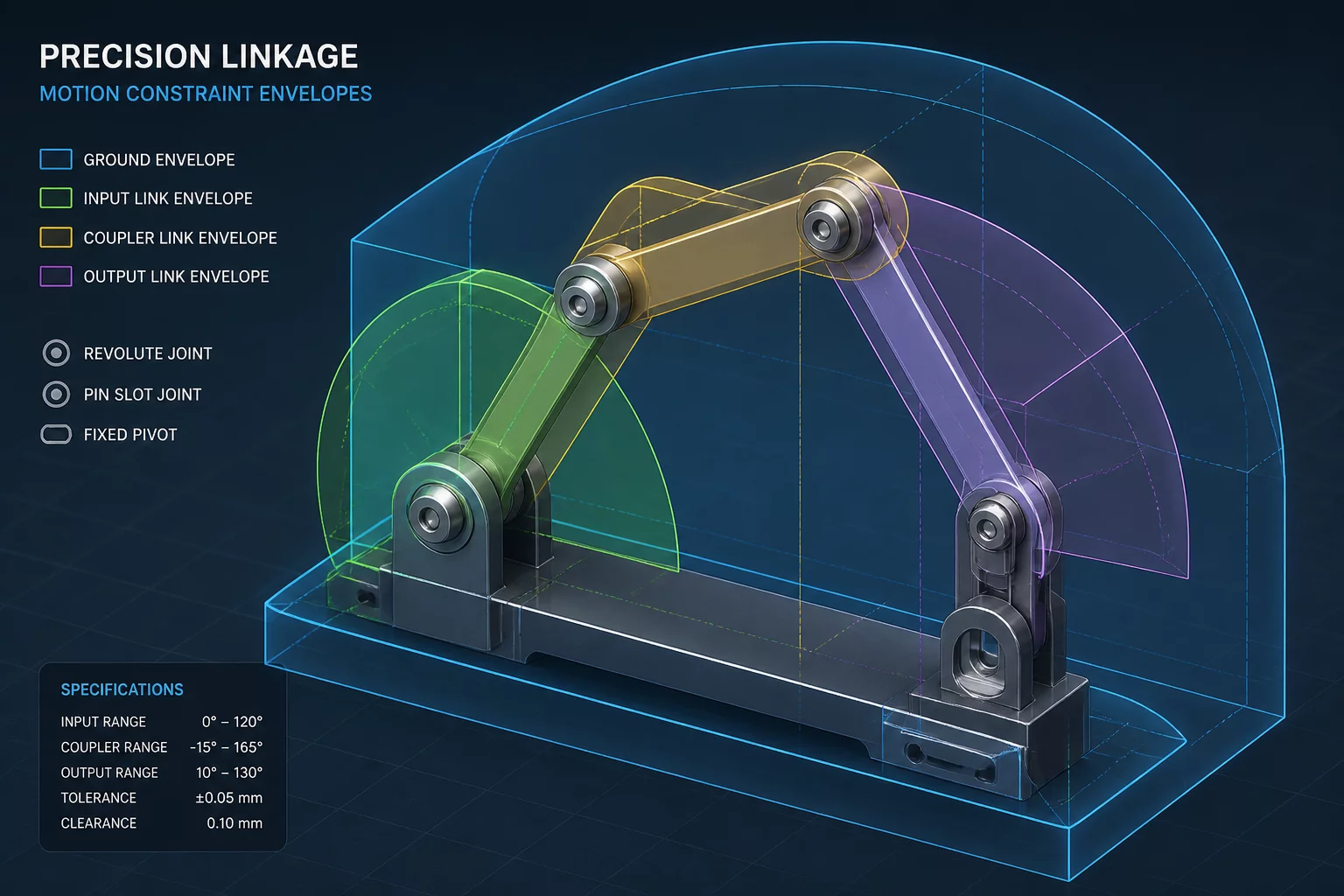
Managing cross-feature geometric dependencies and hierarchical variable rules effectively.

Applying truth tables and boolean condition blocks to control parameter activation states.