Evaluating tabular cross-reference matrices against branching hierarchical decision trees to govern complex variant selection without computational deadlocks.
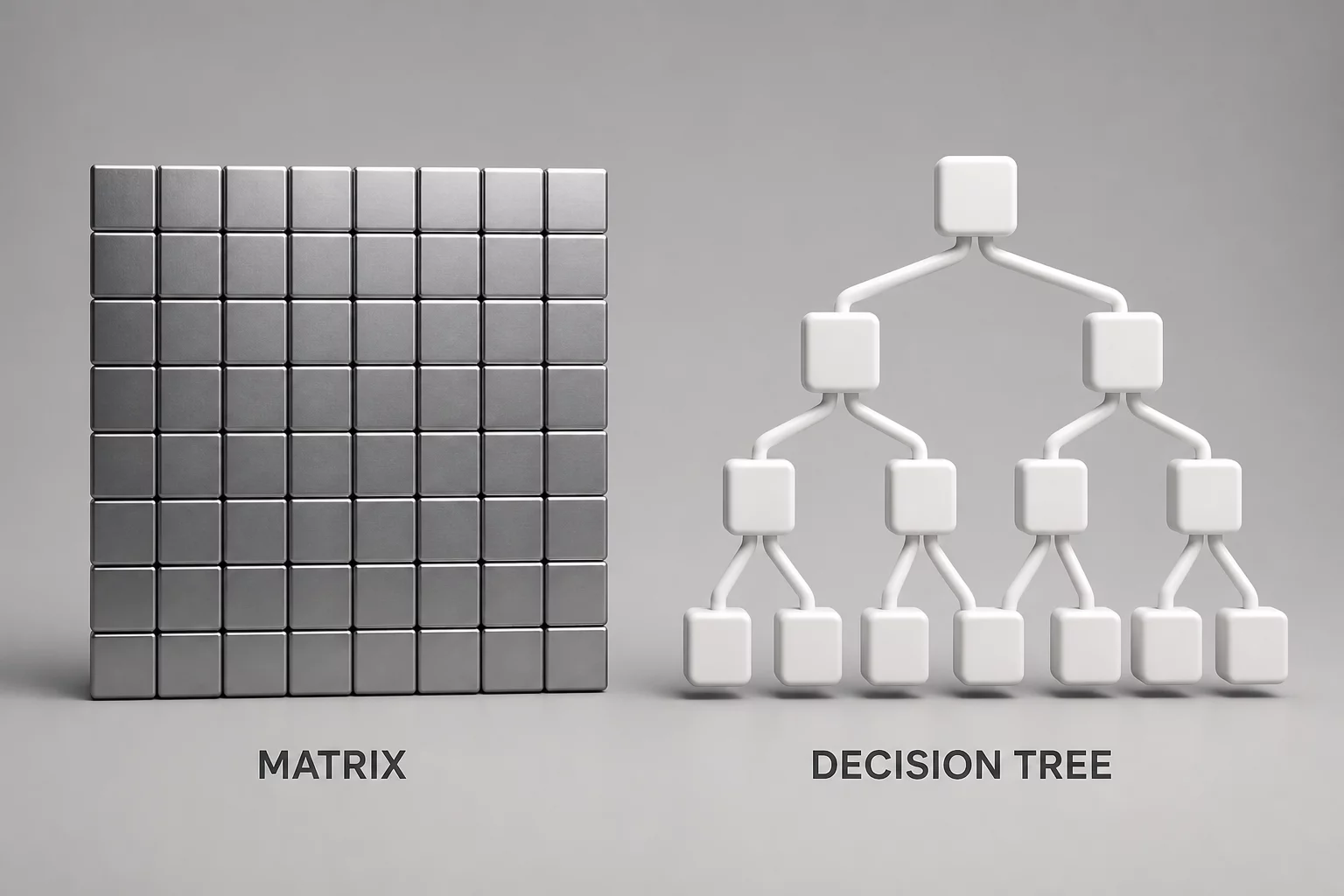
Engineering teams frequently face a fundamental choice when designing product families: represent all valid permutations in a flattened combination matrix or guide users through a sequential decision tree. Tabular matrices lay out all property dimensions concurrently, making orthogonal relationships instantly visible and verifiable. In contrast, decision trees enforce a strict chronological path, evaluating conditions step-by-step to prune invalid downstream variants early.
When parameter interactions are dense and non-linear, combination matrices provide an exhaustive map of all allowed combinations without deeply nested conditional branches. However, when specific configuration choices completely invalidate entire subsystems or change available questions, decision trees eliminate clutter by only showing relevant options based on preceding selections.
The operational performance of each architecture differs significantly as product complexity scales. Combination matrices scale quadratically with added dimensions, quickly becoming unwieldy spreadsheets if hundreds of independent variables interact. Decision trees prevent combinatorial explosion by grouping options into hierarchical sub-assemblies, though they risk path duplication when multiple distinct routes converge on identical end components.
For modern parametric CAD workflows, use decision trees at the high-level system architecture stage to determine major modules, then apply local combination matrices within each discrete module to govern tight component-level fit and dimensional tolerances.
Applying this hybrid technique keeps matrix tables compact and prevents decision tree branches from sprawling across dozens of levels. It delivers deterministic model regeneration in tools like Onshape while keeping authoring rules manageable across multi-disciplinary engineering teams.
Choose Combination Matrices when dimensions are mutually independent, property combinations require global auditing, and variant counts remain under manageable thresholds.
Choose Decision Trees when selections follow strict sequential causality, where primary choices dictate the total structure and interface requirements of downstream parts.
Isolate volatile parameters into local sub-matrices rather than rebuilding expansive global trees whenever new manufacturing variants or options are introduced.
Senior CAD Systems Architect specializing in parametric product configurators, modular assemblies, and constraint resolution logic in cloud CAD environments.

Proven methods to condense multi-dimensional configuration tables into clean, auditable logic matrices.

Managing conflicting rules, dimension boundaries, and property dependencies in complex assemblies.

Techniques for cutting off unbuildable configuration paths early in the selection hierarchy.