Practical guidelines for establishing deterministic relationships between driver inputs, secondary features, and modular assembly instances.
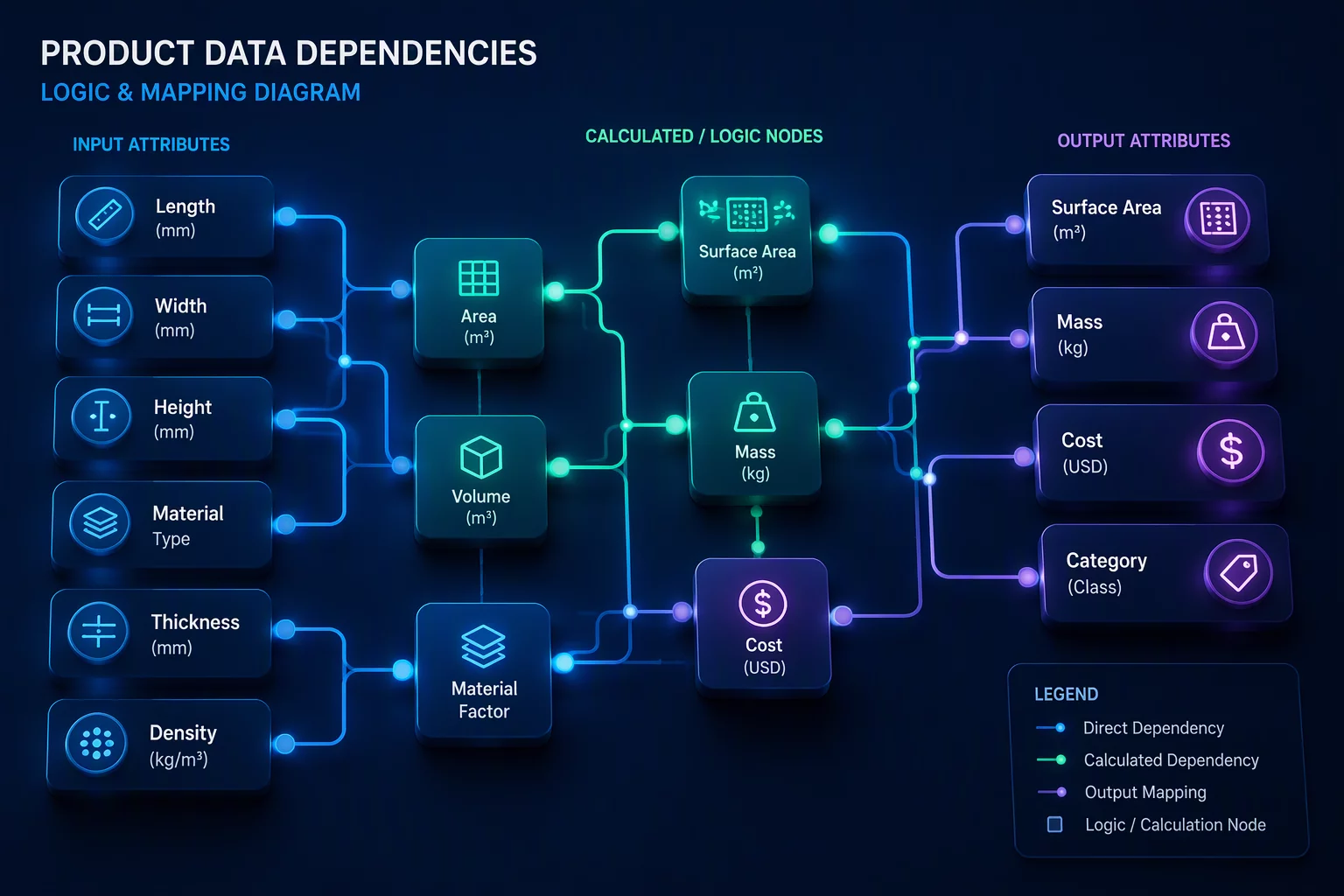
Parametric configuration models depend strictly on the hierarchy of their input parameters. When setting up variable part studios or configurable assemblies, direct relationships must flow unidirectionally from master driving parameters down to localized features. Without clear topological order, models rapidly degrade under edge cases, triggering circular rebuild errors and slow regeneration cycles.
A disciplined dependency map identifies primary drivers—such as structural envelope dimensions or base mounting interfaces—and derives secondary elements automatically. By constraining secondary selections to depend entirely on validated parent states, engineering teams eliminate configuration dead-ends and keep variant spaces fully predictable.
Complex product families demand a decoupled architecture where independent variables reside in a centralized configuration table. Subordinate variables then evaluate logical conditions against these primary states. This prevents parameter collisions across downstream components and ensures that changing an enclosure height immediately propagates correct rib spacing and fastener counts.
Never allow a subordinate feature parameter to feedback into the evaluation of its primary driver. All dependency matrices must resolve as Directed Acyclic Graphs (DAGs) to prevent unresolvable solver loops during runtime variant generation.
When mapping multi-tier assemblies, map dependencies through explicit configuration variables rather than implicit geometric references. Explicit variables can be checked by tabular logic before geometry regeneration begins, saving compute overhead and surfacing incompatible selections before assembly mates fail.
Establish a single source of truth for driver inputs so derived values calculate downstream without intermediate overrides.
Break circular chains immediately by separating physical dimensions from functional option states.
Validate variant branches with automated table permutations prior to releasing production configurations.
James Wilson specializes in parametric CAD system architecture, configuration rulesets, and scalable variant management for complex industrial equipment.

Establish strict bounds, discrete lists, and validation constraints for user-defined configuration inputs.

Strategies for pruning invalid branches and blocking conflicting parameter selections early.

Establish physical manufacturing thresholds and safeguard parametric models against extreme geometry.